Free startup risk register template
A spreadsheet that starts with the 32 risks most startups share, each with a starting rating you can change.
Download the template, delete the risks that do not apply, change the ratings that are wrong for you, and give every risk that is left a named owner. It comes filled in with 32 risks across 5 categories, taken from the same researched library Vetrail starts every register with. Each risk has a likelihood and an impact to start from. The template is free to use and adapt for your own company.
The file opens in Excel, Google Sheets or Numbers.
What the columns mean
| Column | What goes in it |
|---|---|
| Risk, category and what it means | Filled in. Rewrite them in your own words if that helps your team. |
| Likelihood and impact before controls | Filled in with a starting rating. Change any that are wrong for your company. |
| Controls that usually help | Filled in, as ideas. They are not a list you must have. |
| Owner | One person's name, not a team. |
| Controls you have | What you actually do about the risk today. |
| Likelihood and impact after controls | The rating once your controls are counted. This is the one to manage. |
| Treatment, due date and next review | Solve, accept or transfer, by when, and when the risk is next looked at. |
How to rate a risk
Rate likelihood and impact on four levels: Low, Medium, High, Critical. Rate first as if you had no controls, then write down the controls you really have and rate again. A control nobody has checked lately should not bring the rating down much.
Then choose a treatment. Solve means reducing the risk with a control or a change. Accept means recording who accepted it and why. Transfer means moving the cost elsewhere, usually through insurance or a contract. Each one gets an owner and a date.
The 32 risks in the template
Strategic
- Building something customers don't need or won't pay for
- Premature scaling ahead of a confirmed repeatable model
- The business stalls when a founder or key leader is unavailable or in dispute
- Slow to pivot away from a failing product, hire, or decision
- Revenue concentrated in a small number of customers
- Investors and the board lose confidence because they hear too little, too late
- Cap table and equity promises not fully documented
- Enterprise deals stall on security and compliance reviews
Operational
- Single point of failure in infrastructure or a key vendor
- Technical debt that resists scaling
- Security gaps go unnoticed because no one owns security as a whole
- A security incident goes unnoticed, or runs longer and costs more than it should
- Attackers exploit a known weakness that a patch already fixes
- Ungoverned use of AI tools by staff or within the product
- Hiring or culture misalignment in the earliest hires
- A former employee, contractor or outgrown role still has access to systems or customer data
- One person can move money from start to finish
- A serious disruption stops the company serving customers for longer than they will tolerate
- Critical processes live in people's heads
Financial
- Cash flow mismanagement hidden by burn-rate tunnel vision
- Runway shorter than the next fundraise will take
- Nobody can say with confidence what the business earned, and diligence stalls
- Insurance doesn't match what investors, contracts and the business need
- Income and costs in different currencies with no plan for rate moves
Compliance
- The company breaks a rule that applies to it without knowing
- The company does not clearly own its intellectual property
- Commitments made to customers in contracts aren't tracked
- Personal data is used or kept in a way that breaks data protection law
- Tax obligations triggered by growth go unnoticed
Reputational
- Buyers can't see how the company protects them, and trust suffers
- Slow or poorly handled communication makes a security incident worse
- Misconduct stays hidden until it becomes public, legal or expensive
Keeping it current
- Review it on a fixed day each month, even briefly.
- Look again after any big change: new funding, a new market, a large customer, or an incident.
- When an owner leaves, give their risks to someone else that week.
Where a spreadsheet stops
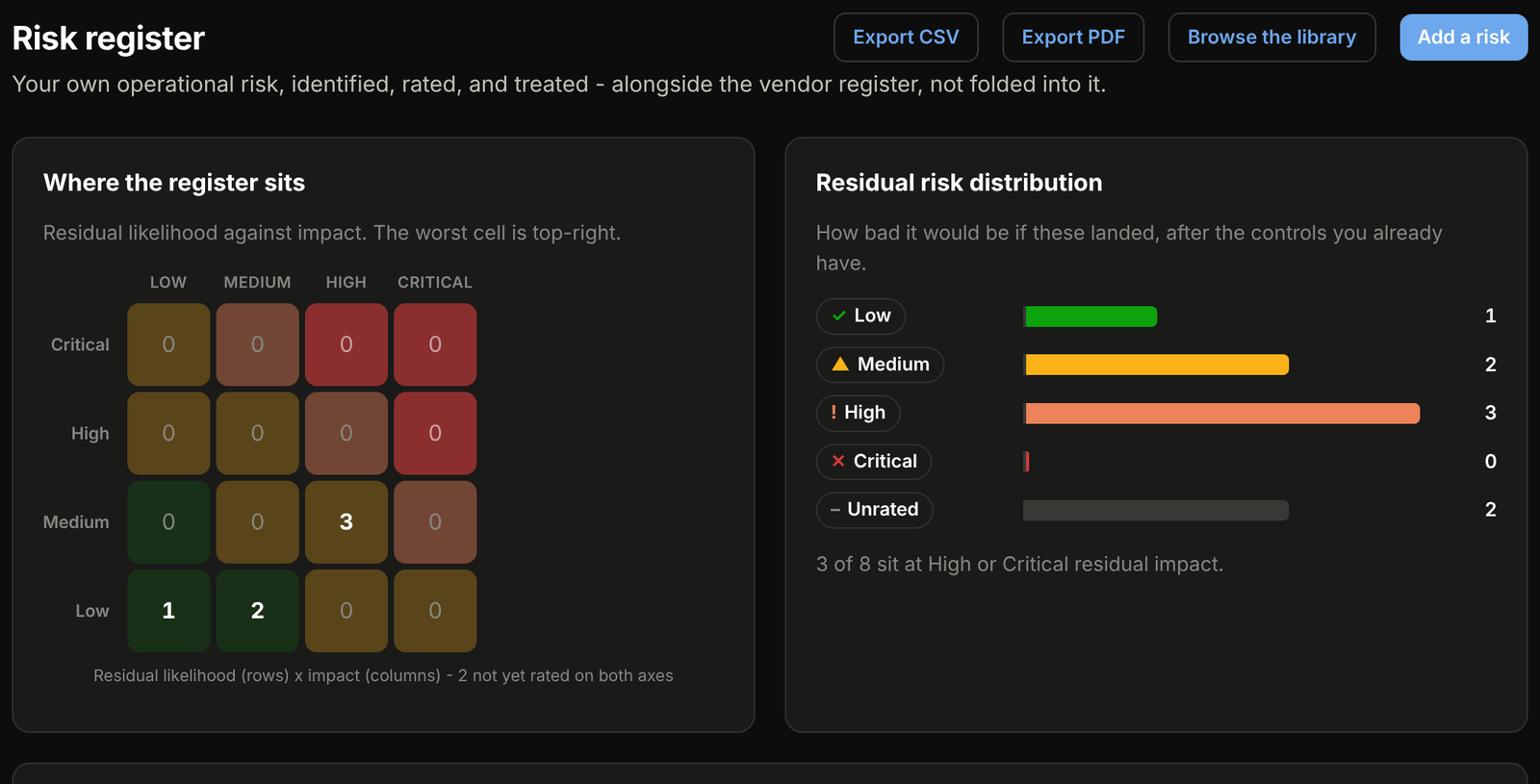
A spreadsheet is a good first register. It cannot remind anyone, it does not know when a control was last tested, and it keeps no record of who changed a rating. When that starts to matter, read when a register is enough and when you need more, or see how Vetrail's register works.
The template holds the risks most startups share. The 72 risks specific to 13 industries are in Vetrail, not in the file. This template is not advice on what any regulator, auditor or investor requires of you.
Start free or take the free risk assessment first
Questions
Can I import the file into Vetrail?
No. Vetrail's register starts from the same library, so you pick the risks there instead. It is
free for up to 5 people.
Why these risks?
Each one is in Vetrail's library because research on why startups fail or get into trouble
points to it, from running out of runway to one person holding a process in their head.
Is it only for security risks?
No. It covers strategic, operational, financial, compliance and reputational risks.
Sources
Last checked 9 November 2026.
Related
- Free vendor risk management software for small teams
- A free alternative to Vanta for vendor risk
- What to do when a vendor will not answer your questionnaire
- A risk register for a startup that keeps itself current
- Free ERM and ORM software for a startup or small business
- Risk register or ERM: what a small team needs
- Free vendor security questionnaire template
- A customer sent us a security questionnaire
- Key person risk: when one person holds the keys