A risk register for a startup that keeps itself current
Most startups keep their first risk register in a spreadsheet. Here is when that stops working, and what Vetrail does differently.
A spreadsheet is a fine first risk register. It stops working when nobody remembers to look at it. Vetrail's register starts with your industry's typical risks already rated, works out what is left once your controls are counted, and brings each control back for testing on its own schedule. It is free for up to 5 people.
Spreadsheet, general work tool, or Vetrail
| A spreadsheet | A work tool you configure | Vetrail | |
|---|---|---|---|
| Where you start | A blank sheet or a downloaded template | A template or a base you design | Your industry's typical risks, each at its usual starting rating and marked as a baseline until you confirm it |
| Ratings | Whatever scale you set, kept consistent by hand | Fields you define | Low, Medium, High and Critical, the same scale as the vendor register |
| Controls | A column of notes | Linked records, if you build them | Each control brings its risk down, and one that fails or goes untested stops counting in full |
| Treatment | A column of notes | Tasks and automations you set up | Solve, accept or transfer, each with an owner and a date |
| Appetite | Not built in | Not built in, unless you build it | Set once, and shown against both registers with what to bring down to get inside it |
When a spreadsheet is still enough
A handful of risks, one person who owns all of them, and nobody outside the company asking to see the register. Keep it simple, review it on a fixed day each month, and give every risk a named owner.
Signs you have outgrown it
- Risks sit in the sheet with no owner, or with an owner who has left.
- Nobody can explain why a risk is rated High rather than Medium.
- A customer, auditor or investor asks to see it, and it takes a week to make presentable.
- Controls are listed but nobody knows whether they still work.
Where Vetrail does not fit
A business with several legal entities, many business units and formal board reporting across them needs a dedicated enterprise risk platform. So does a team where more than 5 people need to edit the register. Vetrail is built for the stage before that.
How it works in Vetrail
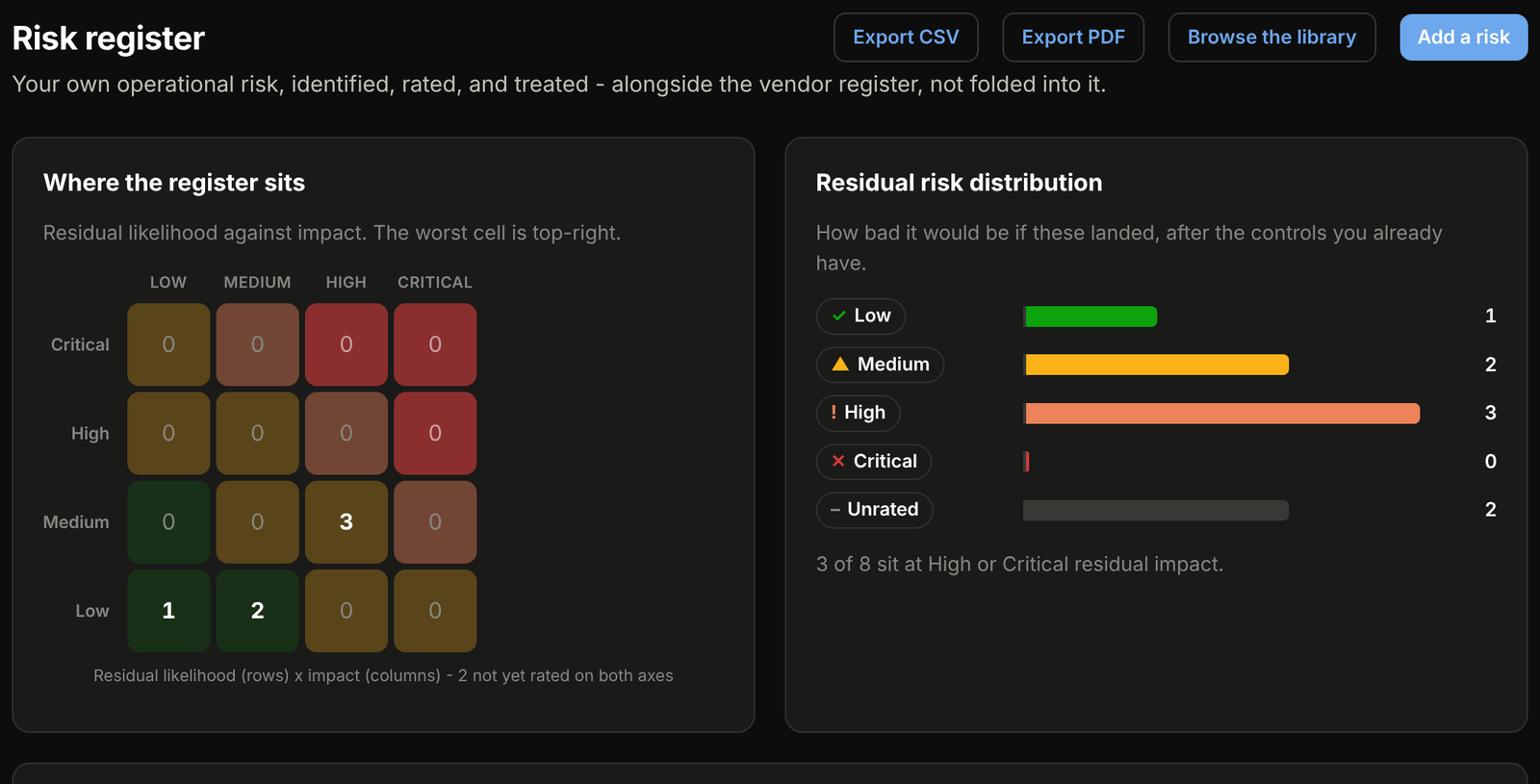
Pick your industry and choose from the researched library, write a risk from a blank form, or describe it out loud to Blaze, which drafts the entry for you to approve. Each risk starts at its inherent rating, you record the controls actually in place, and Vetrail works out the residual rating from them.
Start free or take the free risk assessment first
Questions
Which industries does the library cover?
Fintech, Healthtech, E-commerce / retail, B2B SaaS, Marketplace / platform, Hardware / IoT, Professional services, Trade and skilled workers, Food and beverage, Logistics and transport, Energy and climate, Construction and manufacturing, Real estate. Every risk is available to every workspace. Your industry decides
which ones arrive pre-selected, and at what starting rating.
Is it only for security risks?
No. The library covers strategic, operational, financial, compliance and reputational risks:
key people, runway, processes that live in one person's head, as well as security.
Can I export it?
Yes, as CSV or PDF, and the whole workspace as JSON.
Not sure where to start?
The free risk assessment takes three minutes,
needs no account, and shows where your risk sits against the appetite you choose.
Sources
Last checked 21 October 2026.
Related
- Free vendor risk management software for small teams
- A free alternative to Vanta for vendor risk
- What to do when a vendor will not answer your questionnaire
- Free ERM and ORM software for a startup or small business
- Risk register or ERM: what a small team needs
- Free vendor security questionnaire template
- Free startup risk register template
- A customer sent us a security questionnaire
- Key person risk: when one person holds the keys