Key person risk: when one person holds the keys
The four places it hides in a growing company, and what to put in place before someone leaves, falls ill or falls out with the others.
Key person risk is the chance that the business stalls because one person is away, leaves, or falls out with the others. In a growing company it hides in four places: admin access to the systems, the power to move money, know-how that lives in one head, and what happens if a founder goes. Each one is cheap to fix while things are calm, and expensive to discover on the day that person is gone.
Where it hides, and what to put in place
1. Admin access to the systems
The sign: one person holds the admin login for email, the cloud, the code or the bank, sometimes on a personal account, and nobody else could get in tomorrow.
What to put in place: company-owned accounts with at least two admins, a company password manager, two-step sign-in on every important tool, and a leaver checklist that removes access within one working day.
2. The power to move money
The sign: the same person can add a payee, approve the payment and check the bank statement.
What to put in place: split those three steps between people, have two people approve payments over a set amount, and have a founder look over every payment once a month. In the ACFE's 2024 study of workplace fraud, frauds at organisations with fewer than 100 employees caused a median loss of US$141,000.
3. Know-how that lives in one head
The sign: something stops when one person is on holiday, such as payroll, a release, the month-end close or a key customer relationship.
What to put in place: write down the important, repeated tasks with an owner for each, and have a second person do each one now and then, so you find the gaps while the first person is still there.
4. What happens if a founder goes
The sign: nobody has written down who decides what, or what happens to a founder's shares and work if they leave.
What to put in place: written decision rights, with a named stand-in for every key leader, and a founder agreement that covers leaving, including vesting and who owns the work. A lawyer should draft that agreement.
Behind all four, keep a short list of the people, systems and suppliers the business cannot run without, with a backup for each.
What key person insurance does and does not do
Key person insurance is a policy the company owns on an important person, paying out on their death and, in some policies, a critical illness or disability. The company receives the money and uses it to keep going while it recovers. It covers the financial loss. It does not replace the person or what they know, so the steps above still matter.
Where this guide stops
This is general guidance, not legal, tax or insurance advice. A founder agreement needs a lawyer, and insurance needs a licensed adviser.
How Vetrail helps
Vetrail's risk library includes these four risks for every company:
- The business stalls when a founder or key leader is unavailable or in dispute
- A former employee, contractor or outgrown role still has access to systems or customer data
- One person can move money from start to finish
- Critical processes live in people's heads
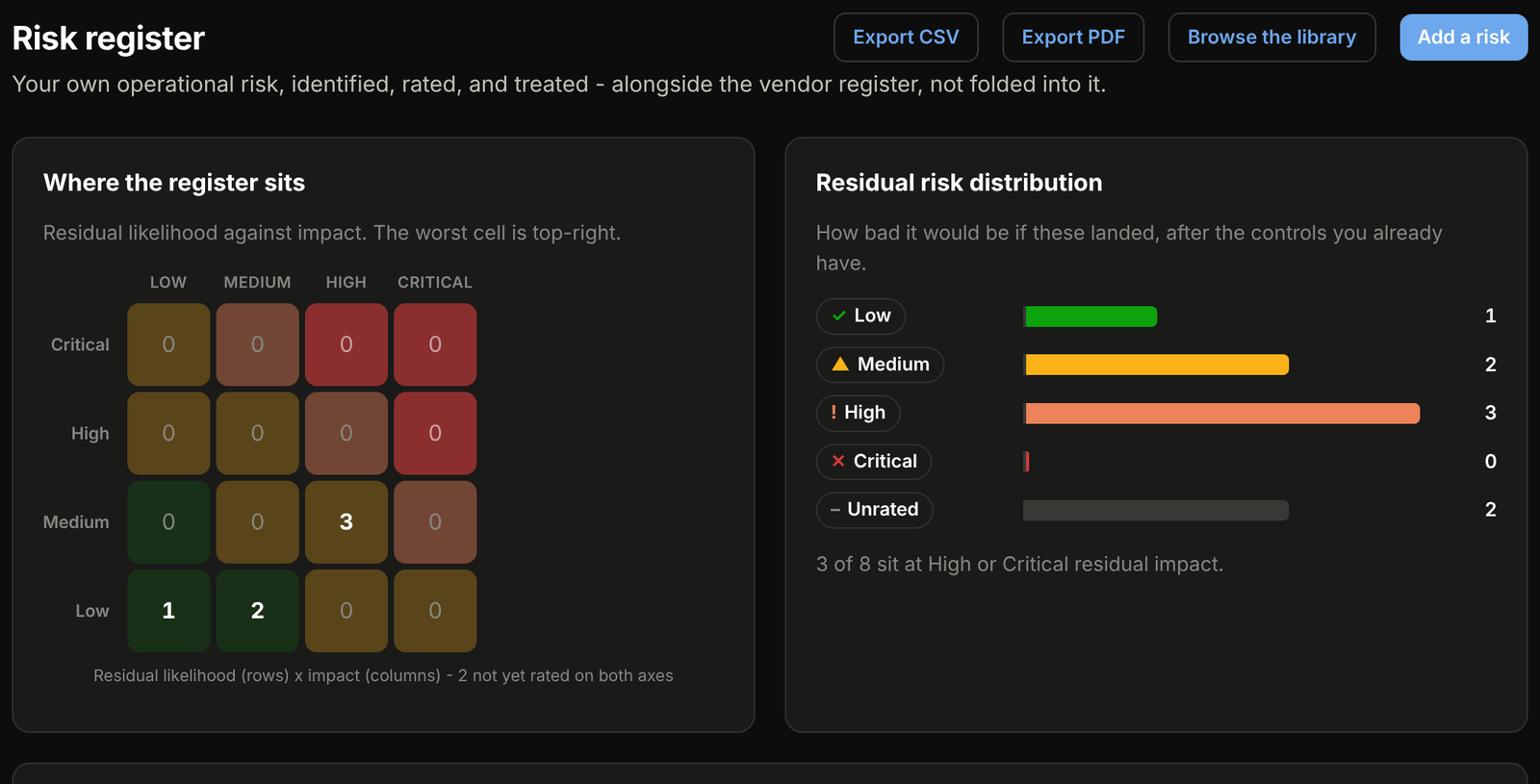
Each comes with the controls that bring it down, such as "One company login and a password manager", "No one person handles a payment alone", "Key tasks written down" and "Who decides what, with a stand-in". Each control comes back for testing on its own schedule, from every 3 months to every 12. Each risk gets an owner and a next review date. It is free for up to 5 people.
Start free or start from the free risk register template
Questions
How do I know if we have a key person problem?
Pick one person and ask: if they were unreachable for two weeks from tomorrow, what would stop?
Then do the same for each founder.
We are only a few people. Does this apply?
Yes, and more so, because each person covers more. Admin access and money are the two to fix
first.
Is "bus factor" the same thing?
Yes. It is the engineers' name for how many people you would have to lose before work stalls. A
bus factor of one is key person risk.
Sources
- Occupational Fraud 2024: A Report to the Nations, ACFE (copy hosted by Ivey Business School)
- Should small businesses insure key people?, Advisor.ca, 2018
- How Vetrail works
Vetrail is not affiliated with the ACFE or Advisor.ca. Last checked 10 November 2026.
Related
- Free vendor risk management software for small teams
- A free alternative to Vanta for vendor risk
- What to do when a vendor will not answer your questionnaire
- A risk register for a startup that keeps itself current
- Free ERM and ORM software for a startup or small business
- Risk register or ERM: what a small team needs
- Free vendor security questionnaire template
- Free startup risk register template
- A customer sent us a security questionnaire